Postgres for Agentic AI: Your Database Is a Compute Layer, Not a Parking Lot
PostgreSQL is already the default database for agentic AI. That question is settled. But the more agentic your workloads get, the more your database needs to do. Models and workflows flood it with signals, state, memory, and checkpoints, and most teams just absorb the flood, treating PostgreSQL like a parking lot rather than a compute layer. The people building these systems are AI engineers, not database people. They haven't explored what PostgreSQL can actually do when you treat it as a first-class compute citizen.
Production agentic AI creates workload patterns that look nothing like anything most teams have operated before. Agents write intermediate results, update shared state, run concurrent multi-step workflows against the same tables, and do all of this without coordinating with each other. Your chatbot is pulling RAG context from a table that a data-cleaning agent is actively updating, while a forecasting agent parks half-finished calculations in a scratch table that three other processes read from.
The demos look great, but the architecture decisions at the database layer determine whether your agents run reliably at scale or whether you spend Monday mornings untangling a mess that autonomous processes made over the weekend.
What Agents Actually Do to a Database
Agentic AI workloads split along a line most teams don't draw clearly enough: the difference between agent memory (what the agent knows and recalls across sessions) and agent state (the checkpoints, scratchpads, and coordination data that keeps a workflow running). Princeton's CoALA framework formalized this taxonomy, and Harrison Chase has argued that agent memory creates durable lock-in you shouldn't cede to your model provider. These essentially map to four database patterns, each putting different pressure on PostgreSQL.
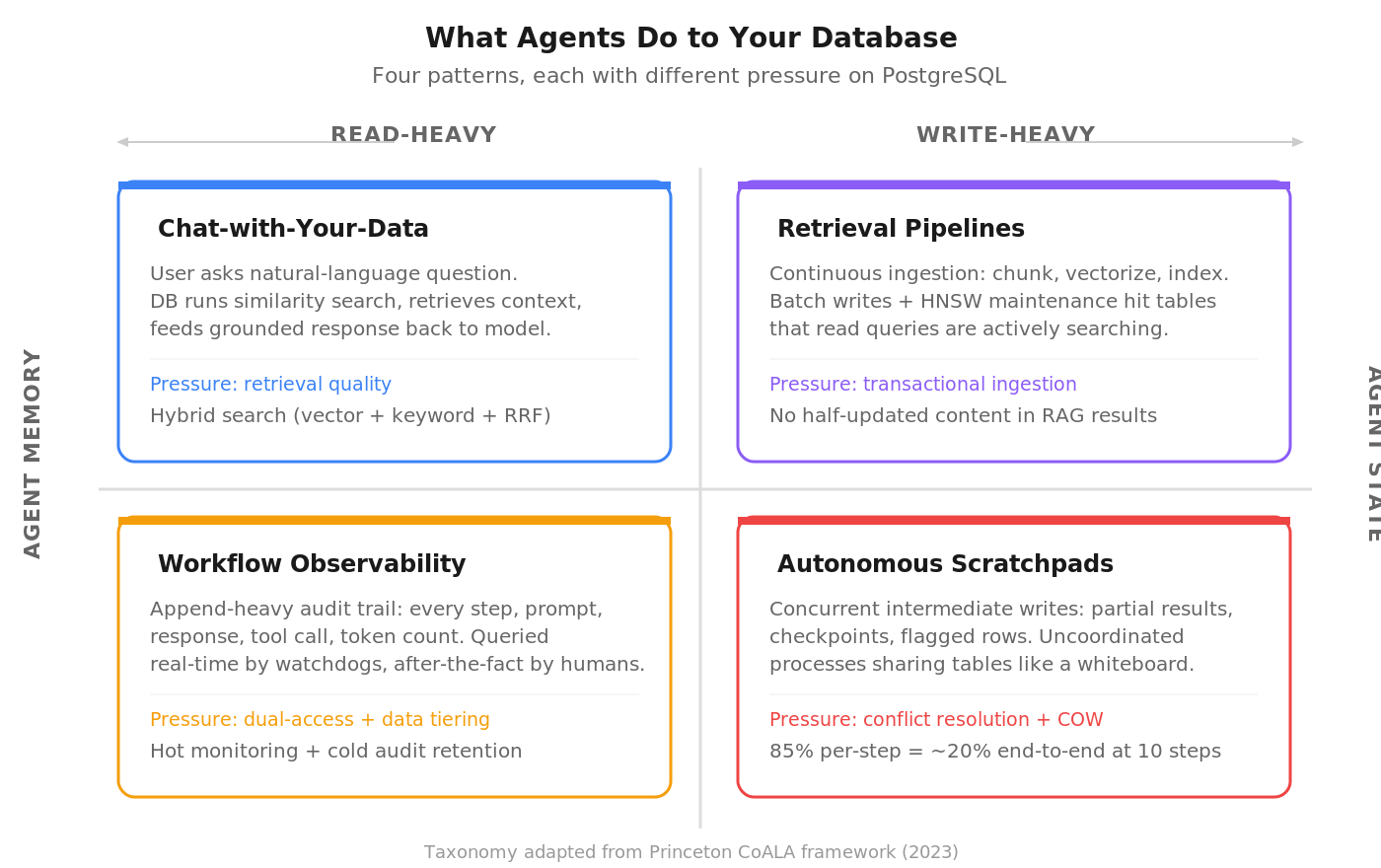 Chat-with-your-data is where most teams start. A user asks a question in natural language, the database runs a similarity search against stored vectors, retrieves relevant context, and feeds it back to the model for a grounded response. The database work is read-heavy, and the challenge is retrieval quality. A support agent needs documents that match the customer's question semantically and contain the exact product SKU. Vector similarity misses the SKU, keyword search misses the concept.
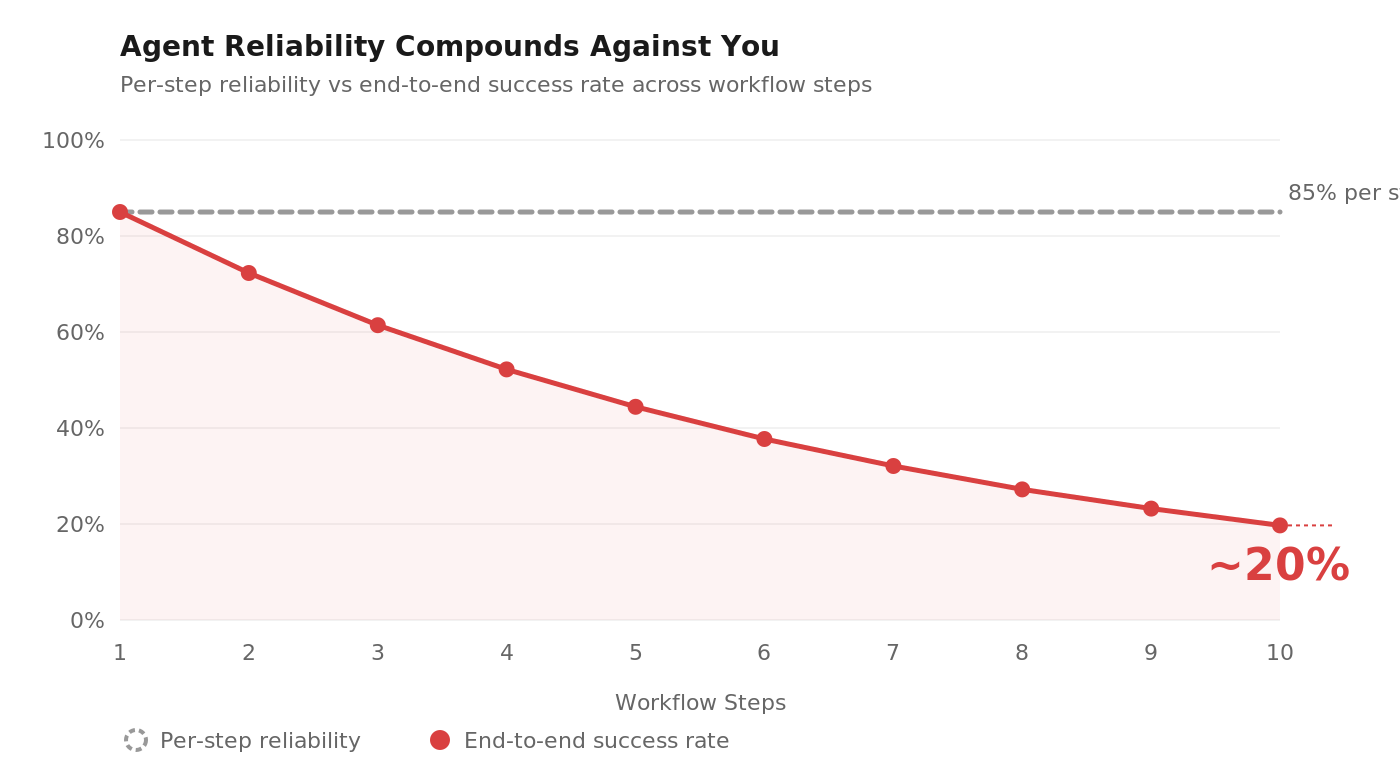
Autonomous agent scratchpads break most architectures. An agent working through a multi-step task needs somewhere to store intermediate results: partial forecasts, decision tree evaluations, rows flagged for review. Copy-on-write database branching is becoming table stakes here, giving each agent an isolated workspace without cloning the entire database. And critically, the agent needs checkpointing. At 85% per-step reliability, a 10-step agent workflow succeeds about 20% of the time end-to-end. LangGraph's production architecture is built around exactly this: snapshotting full workflow state to PostgreSQL at every super-step so you resume from a known-good checkpoint when step seven fails, rather than restarting from scratch. The database is the recovery mechanism.
 These writes are concurrent, they come from processes that don't coordinate with each other, and they target tables that other agents might be reading simultaneously. The scratchpad pattern turns your database into something more like a shared whiteboard than a system of record, and shared whiteboards need conflict resolution.
Retrieval for LLM pipelines spans both memory and state. Documents flow in continuously and each needs to be chunked, vectorized, and indexed for retrieval. The pipeline runs asynchronously while the retrieval layer serves queries against content that's being updated in the background. Batch writes, HNSW index maintenance, and read queries all hit the same tables, and the ingestion process needs to be transactional so a RAG query mid-pipeline doesn't search against half-updated content.
Workflow orchestration and observability doesn't get attention until someone is debugging a production failure at 2 AM. In any serious agentic deployment, the agents aren't working alone. A development workflow might have Agent A generating code, Agent B reviewing it, Agent C running tests, and a supervisor agent deciding whether to loop back or ship, with a watchdog monitoring the whole pipeline for cost overruns or hallucinations.
Every step in that chain generates data that needs to land somewhere durable: which model was called, what the prompt and response contained, how many tokens it consumed, which tools were invoked, what those tool calls looked like. This isn't optional logging for debugging convenience. The EU AI Act's high-risk AI provisions take full effect in August 2026, mandating tamper-resistant audit trails with minimum retention periods and carrying penalties up to 3% of global turnover. Even outside the EU, the principle is the same: if your autonomous system approved a loan, cleared a compliance check, or authorized a trade, you need database-level proof that it did what it was supposed to do, in the order it was supposed to do it, and didn't quietly hallucinate an approval along the way.
The database pattern is append-heavy, relationally structured (workflow runs, steps, tool calls linked by foreign keys), and queried in two very different modes. Watchdog agents query it in real-time, checking whether the current workflow is still within budget. Humans query it after the fact, walking backwards through the execution chain to find where a bad output originated. That dual-access pattern needs careful index design, replication that keeps the watchdog's view current across nodes, and a storage strategy that doesn't let audit tables eat your entire disk budget. Data tiering solves this: the last 48 hours of workflow logs need to be hot and fast for real-time monitoring, but the six months of execution history you're required to retain can live on commodity object storage at a fraction of the cost, still queryable through the same SQL interface.
Why Convergence Wins
The whole point is convergence. Rather than stitching together a vector database, relational database, search index, and archive tier, everything runs inside PostgreSQL. Jerry Liu co-authored a LlamaIndex post arguing that combining vector embeddings, relational data, and time-series data in one PostgreSQL database eliminates the operational complexity of managing multiple systems at scale. LangGraph recommends PostgreSQL as its production checkpoint backend. Purpose-built vector databases can beat pgvector on raw similarity benchmarks. But running and syncing separate systems costs more in ops overhead than the latency difference is worth for most production workloads. The converged engine wins because agent workloads don't respect the boundaries between "vector query" and "relational query" and "full-text search."
When Agents Write Back
A chatbot that only reads data is a solved problem: point it at a read replica and scale horizontally. But production agentic AI is where agents take action. They update records, log decisions, write intermediate state, trigger downstream workflows. And in multi-agent systems, agents coordinate with each other through the database itself.
This is the architectural shift most teams underestimate. Multi-agent coordination needs a shared state layer, and most teams build it in application code: Redis for task queues, custom state machines for workflow progression, polling loops for status checks. Every one of those is a system to operate, a failure mode to handle, and a consistency boundary you have to reason about separately from your data.
PostgreSQL already has the primitives. SELECT FOR UPDATE SKIP LOCKED turns an ordinary table into an atomic task queue: agents claim work without contention and without external dependencies. LISTEN/NOTIFY lets agents react to events without polling. Advisory locks coordinate access to shared resources without locking rows. And MVCC means a forecasting agent and an inventory agent can write to the same tables concurrently without seeing each other's uncommitted work. These aren't exotic extensions. They're core PostgreSQL, battle-tested for decades in workloads that look exactly like multi-agent coordination: job schedulers, workflow engines, event-driven pipelines.
The point isn't that PostgreSQL replaces your orchestration framework. It's that the durable coordination state belongs in the database, not beside it. When your coordination state lives in the same transactional store as your business data, rollback, recovery, and audit come for free. Build it in application code and you're reimplementing ACID, badly.
What Your Agentic AI Database Actually Needs
Strip away the marketing, and production agentic AI comes down to five concrete requirements at the database layer. If you're evaluating options, these are the questions to ask.
Structured agent access, not raw SQL. PingCAP reported that over 90% of new clusters on TiDB Cloud are now provisioned by AI agents, not humans. Agents are becoming the primary consumers of database infrastructure, and giving them a raw connection string is how you get DROP TABLE in production. The MCP Server provides schema discovery, query execution with read-only transactions by default, EXPLAIN ANALYZE for diagnostics, and a built-in PostgreSQL knowledge base. Agents get speed without excess permissions: write access is opt-in, scoped per-database, and logged for audit. Because MCP mediates all agent interaction, you get observability at the interface, not scattered across frameworks.
Retrieval that actually works. This is the agent memory problem in production. Pure vector similarity returns results that are semantically related but might miss exact matches. Pure keyword search catches exact matches but misses semantic connections. Production RAG needs both, and the pgEdge stack delivers this with pgvector for cosine similarity, VectorChord BM25 for keyword ranking, and Reciprocal Rank Fusion to merge the results. The Vectorizer handles chunking and embedding generation, with Markdown-aware splitting that respects document structure.
Agentic operations that keep up with agentic engineering. Agents don't just add workload to existing databases. They multiply the databases themselves. Development branches, per-agent scratchpads, staging environments for autonomous testing pipelines: your DBA team was already stretched thin before agentic AI added a zero to their fleet count. The pgEdge AI DBA Workbench puts AI-powered monitoring across your entire database estate, with natural-language alert analysis, fleet-wide health summaries, and an AI assistant that can query metrics, inspect schemas, and correlate events across clusters. A single DBA can monitor 10 or 20 times the instances they managed before, while keeping a human in the loop.
Sovereign control over your data. Agentic AI in regulated industries means your database needs to run where the data is allowed to live: managed cloud, on-premises, or fully air-gapped with Ollama for local embeddings. The pgEdge stack runs in all of these environments because every component is open-source PostgreSQL with no proprietary dependencies. Not only that but we've done the hard work of building, testing and validating binaries and packages for the exact OS and hardware configurations enterprises are running on
Data lifecycle that doesn't bankrupt you. Agentic AI generates data at a rate that traditional database sizing models don't account for. Every workflow execution, every tool call, every token-counted LLM interaction creates rows that need to exist somewhere. Over time, data storage costs for production agentic workloads can dwarf compute costs.. ClickHouse acquired Langfuse (the leading open-source LLM observability platform) in early 2026, in part because trace volumes are a natural fit for column-store analytics rather than hot PostgreSQL storage. The answer is tiering the data, not abandoning Postgres. ColdFront handles this transparently, moving data between native PostgreSQL (hot, fast, expensive) and Apache Iceberg on S3 (cold, queryable, roughly 90% cheaper). Your agents keep querying the same table names with the same SQL. Recent workflow logs live in hot PostgreSQL partitions for sub-millisecond watchdog access, while historical audit trails archive to Iceberg where compliance teams can query them without paying hot-storage prices for data touched once a quarter.
Where to Start
The pgEdge Agentic AI Toolkit bundles all of this into a single installable stack: MCP Server, Vectorizer, RAG Server, Docloader, pgvector, and the search extensions. If you want to start with the agent interface, the pgEdge Postgres MCP Server is open source and works with any PostgreSQL 14+ database, including RDS and Aurora. Connect it to Claude Code, Cursor, or any MCP-compatible client and point it at your existing database. With over 100 million monthly SDK downloads and the protocol now under the Linux Foundation's Agentic AI Foundation, MCP is the emerging standard for agent-to-tool communication. Google's A2A protocol is taking shape for agent-to-agent coordination, and PostgreSQL is the durable layer underneath both.
The database layer for agentic AI isn't a feature you bolt on. It's an architecture decision that determines whether your agents can operate autonomously at scale, or whether they're one concurrent write away from a production incident.